🚨 DEUTSCHLAND UND ÖSTERREICH IM DIPLOMATISCHEN MACHTKAMPF: Wer schnappt sich den begehrten Sitz im UN-Sicherheitsrat?

NEW YORK — In the heated Austro-German fight over which country will win a prized seat on the United Nations Security Council, Austrian officials are resorting to some wry diplomacy and a simple message.
Vote for us “precisely because we’re not the Germans,” as one senior Austrian diplomat put it.
Behind the tongue-in-cheek jab lies a real rivalry and fierce competition between two countries normally viewed as close allies.
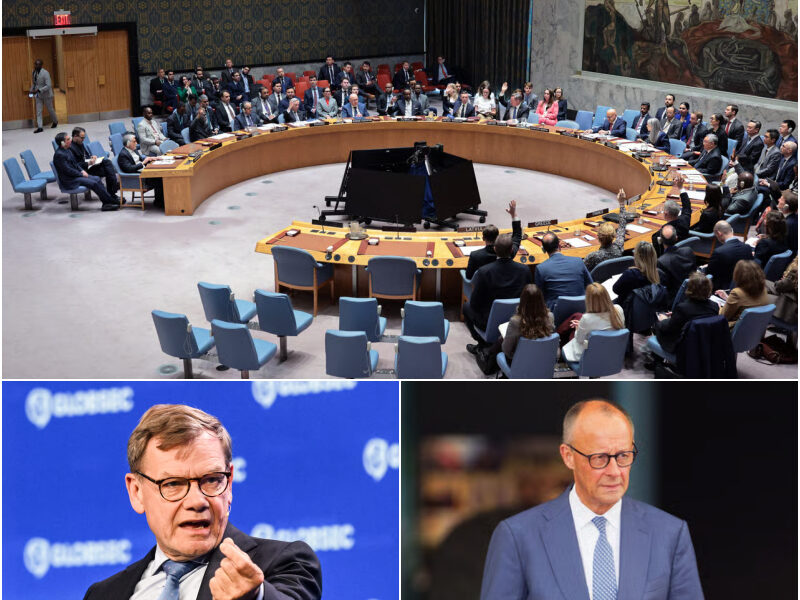
Three EU countries — Germany, Austria and Portugal — are bidding for two non-permanent seats on the U.N.’s most powerful body in a General Assembly vote set for Wednesday. Portugal, thanks to its strong ties with Portuguese- and Spanish-speaking countries, is generally regarded as a shoo-in for the two-year term beginning in 2027. That leaves Germany and Austria — countries bound by close historical and cultural ties, but also occasional tensions — competing for the final seat.

Germany is the Goliath in the contest, yet that has not stopped German Foreign Minister Johann Wadephul from aggressively lobbying Berlin’s case, reflecting Chancellor Friedrich Merz’s determination to secure every possible source of international leverage to bolster Germany’s export-driven economy and strengthen its influence on the global stage. Wadephul flew to New York at the end of last week to lobby countries to vote for Germany.
“When it comes to global crises, Germany wants to bring its influence to bear,” Wadephul said shortly after his arrival. “That is only fitting for the world’s third-largest economy.”
Austrian diplomats, by contrast, have been making a virtue of their relative diminutiveness.
“As a small country that is nonaligned and militarily neutral, we can play a very special role: Because it’s not about the rights of the political heavyweights, but the balance of rights among all states,” said the Austrian diplomat, speaking to POLITICO on condition of anonymity to freely discuss a sensitive matter.
German and Austrian leaders have been unusually candid about how hard they’ve pushed to outmaneuver one another.
“We have done everything in our power — including the federal foreign minister and myself personally, as well as many colleagues in the cabinet — to ensure that we receive the approval of the United Nations General Assembly for a non-permanent seat,” Merz said in Berlin on Tuesday alongside Hungarian Prime Minister Péter Magyar, who said he would support the German bid.
Austria’s chancellor and foreign minister too have “gone all out” to win the contest, according to the Austrian diplomat.
Gregor Kössler, Austria’s ambassador to the U.N., said there is some “hardball stuff going on behind the scenes” in an interview with Austrian news outlet Die Presse.

“People are trying to flip votes and poach supporters,” he said. “Especially when you’re playing catch-up, you might try to push a little harder to overturn existing agreements.”
Another humiliation for Merz?
Austrian diplomats say their non-alignment and lack of NATO membership gives them an advantage with countries in Africa, Asia and Latin America. The Austrian side has another clear advantage, having entered the fray for the 2027-2028 seat several years before Germany did — and they believe, partly due to this, that they have a realistic chance of beating Germany in the vote Wednesday.
That outcome would be a humiliation for Merz. Berlin has for decades managed to win a Security Council seat every eight years. Defeat to Austria would not only mark a painful diplomatic setback, but also likely lead to further domestic criticism of an already-unpopular and politically weakened Merz, who ran for office on a promise to restore Germany’s leadership role within Europe.
This helps explain why Wadephul has been campaigning hard in New York.
Wadephul has met about 80 ministers or ambassadors in person at the U.N. since Friday, according to representatives familiar with his efforts. It’s unclear what carrots he may be offering. In such circumstances, diplomats often trade votes, offering future support in exchange for backing in the present. Germany — a leading U.N. donor with a broad international footprint — potentially has more levers to pull than Austria.
Wadephul has also tried to engage in some soft power persuasion. On Monday night, the German foreign minister hosted a large reception on U.N. Plaza featuring a jazz band, German sausage and an ice cream stand.

Wednesday’s vote among 191 U.N. members will take place in rounds until two countries secure the two-thirds majority required for a Security Council seat. Voting is with a secret ballot — a fact that appears to be intensifying competition as diplomats from both Berlin and Vienna see a chance to sway countries up until the last minute without anyone losing face.
One factor that could prove decisive in the vote is Merz’s disparaging remarks about international law at the start of the war in Iran. Another is what many member countries view as Germany’s reluctance to condemn Israel for civilian casualties during its military campaigns in Gaza and Lebanon — though Austria too is traditionally one of Israel’s strongest European backers.
Wadephul, in recent days, however, has criticized Israel’s campaign against Hezbollah in Lebanon in stronger terms, issuing a statement on Sunday expressing “grave concern” over the Israeli army’s advance into the southern part of the country and calling on Israel’s leaders to “protect civilians and civilian infrastructure.” On Tuesday, he said Germany will be an “advocate for international law.”
Ultimately, however, the outcome of Wednesday’s contest may well be determined by which side performs better at the cutthroat diplomacy playing out ahead of the contest.
On Tuesday in New York, Wadephul made an argument certain to raise Austrian ire. His argument, in short: You don’t want two small EU countries — Portugal and Austria — on the Security Council, so choose us instead.
“For many countries, a hybrid approach might be just the right solution: having a smaller European country and Germany on the Security Council,” he told reporters outside the U.N. headquarters.